

What is a power coefficient and what is it used for
The power coefficient is a similarity relation for the power, following from combining the flow coefficient and head coefficient. As flow conditions are similar, hydraulic efficiency remains unchanged as well, the shaft power of the machine will change proportionally with the hydraulic power. It is a dimensionless coefficient which is assumed to be constant for pumps with similar flow conditions.
The capacity Q, the head H and the speed N are used to define the similarity relations for the flow coefficient ϕ and head coefficient ψ. Along with the efficiency these quantities describe the performance of a pump in its entirety. Therefore, a similarity relation for the power can also be easily derived. The hydraulic power Ph required by a pump is used as a starting point.
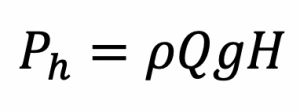
Substituting Q following from the flow coefficient and substituting gH following from the head coefficient and rearranging yields the similarity relation for the hydraulic power.

As both the flow coefficient and head coefficient are involved, flow conditions are still assumed to be similar. While deriving the head coefficient it is assumed that all forces within the pump (inertia forces) have the same relation to the velocities in the pump and thus the ratio between the hydraulic losses and the total energy transformation is constant. In other words, the hydraulic efficiency of a pump is constant for any variations in the performance characteristics as long as the head and flow coefficient remain unchanged, i.e. similarity considerations are satisfied. The shaft power of the machine changes proportionally with the hydraulic power which yields an expression for the power coefficient Pc.

