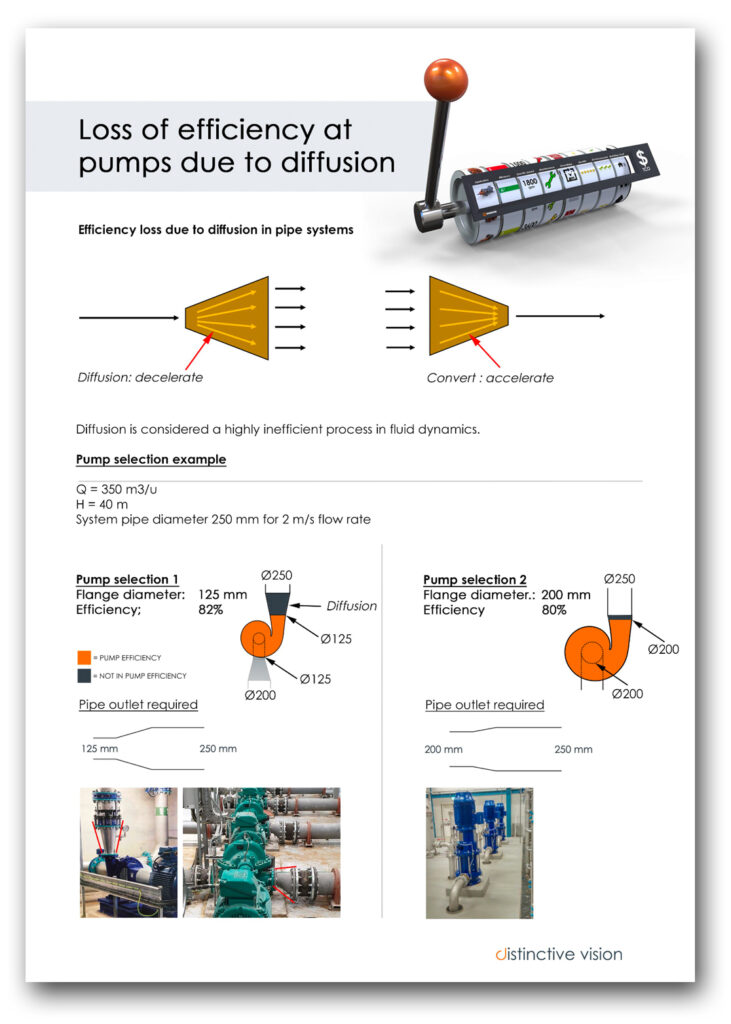
Efficiency loss due to diffusion in pipe systems
At Rodelta, we regularly see pictures on the internet of pump installations where large conical pipes are placed in front and behind the pumps. The purpose of these conical diffusion and contraction parts is to bring the liquid speed back down to the acceptable line speeds of the pumped medium. This is necessary to prevent pipe cavitation. What not everyone knows is that this is actually not necessary at all if a good pump selection has been made. Often, the user does not have the in-depth knowledge of pumps to understand this.
This phenomenon is regularly abused by pump companies that want to sell their products. Pumps are selected that run faster (higher liquid speed). The pump efficiency at one point of these pumps is often good and therefore attractive in their offers. But another additional advantage is that due to the high speeds, the pump can also be made smaller, which means a lower price. So two advantages that favor their offer. But what is never mentioned in their offers are the convert and diffusion losses in the reducers which are required when selecting their pump type. These parts are outside the pump scope but are necessary.
So, in addition to the disadvantages of efficiency, there are also the noise-generating diffusers that you, the end customer, have to pay for.

Pump selection example
Below we give a simple example where initially selection 1 seems to be better. However, when one looks closely, selection 2 “which seems less attractive” turns out to be a better choice. In addition, due to the lower speeds, this second choice is also better with regard to maintenance costs. After all, lower speeds mean less wear of the parts and less noise production. (In addition, the diffusion parts also produce a lot of noise when burning the flow energy to get back to the usable flow speed “max 4-5 m/s”).
Principles of the example:

The picture above shows the progression from the pump outlet to the pipework diameter. From this we can calculate the loss, which must be subtracted from the pump efficiency to get the correct pump efficiency.


Another additional possibility may be that the diffuser is mounted directly on the pump end, there will be an interaction between the flow in the outlet of the pump and the diffuser. This interaction increases the losses even more.

Advice and be aware!
Always choose 5 – 7 times the inlet diameter of the pipe as straight length in front and behind the pump.
Constant diameter, equal to pump connection.
Pumps with small connection diameters can cause large system losses.
- Higher discharge velocity increases the velocity energy in the liquid quadratically.
- Larger surface area ratio increases loss factor.
- Combined effects increase pressure loss. At high discharge rates, this loss can be several percent of the delivery head and several percent of the pump efficiency.
For a fair comparison of quotations on pump systems, it is very important to look properly at the variations in connection diameters (i.e. liquid velocity) from the pump selections. The example on this webpage shows that this has a great influence on the final net pump efficiency.