

Advantages Concrete Volute Pump (CVP) compared to a Vertical Turbine Pump (VTP).
This page will indicate the advantages of using a Concrete Volute Pump (CVP) compared to a Vertical Turbine Pump (VTP) design. Both pump types are used in applications with (very) high volumes of liquid at low or medium heads. These applications can be for different market segments like Power (cooling water), Desalination, Oil & Gas, Irrigation and Flood/Storm water control.
As Rodelta is manufacturing both VTP as CVP design, we can provide objective remarks on each design. Main purpose is to indicate benefits and advantages of the design for the specific application. The customer can evaluate each feature against the requirement which is most important to the application (e.g. efficiency, reliability, maintenance, sustainability, etc.)
Characteristics CVP
- Wide operating range in which the pumps can operate.
- The combination of a steel-mounted rotor unit placed in a volute made of concrete allows larger flows to be pumped with less quantity of pumps. The manufacturing and assembly of the pump remains manageable for these larger sizes. Compares to similar size of the VTP design the cost are less.
- The CVP design has a high degree of reliability and higher efficiency.
Pumps which needs to handle large volumes of water at low or medium heads, needs to be designed considering manufacturing, assembly and maintenance. The dimensions of the CVP pull-out unit remain manageable as the volute design is made of concrete elements. These prefabricated elements are commonly used in the concrete construction industry.

In contrast, the dimensions of a VTP, designed for the same flow rate, are so large that manufacturability becomes a challenge. Main reason is that the VTP design consists of a bowl around the impeller with diffuser vanes to guide the flow towards the discharge. Below figures shows the larger dimensions of the VTP compared to the CVP. One can imagine the challenges for casting, machining, transporting and maintaining this size of bowl and riser tubes.

Besides the handling of the larger pump parts, this size also has impact for the cost. Figure 2 is showing the metal parts in red that are in contact with the pumped medium. This is significantly more for a VTP design than for the CVP design. For several applications these pump parts come in contact with aggressive fluids such as warm sea water. In those applications the red-coloured parts are often made of higher-grade corrosion-resistant materials, for instance Duplex or Super Duplex. Compared to concrete (volute material of CVP) the cost of this material is significant, also considering the operational spare parts during operations.
Our CVP is executed with a dry shaft construction, which means that the shaft parts that are protected by sleeves in the liquid and made of corrosion-resistant materials. With a VTP version, this becomes more expensive due to the length of the shaft.

Regarding the construction of the pumps station. The required depth of the pit for a CVP design is considerably less compared to the pit depth required for VTP type. The CVP has a clever suction box and flat volute design which enables perfect suction conditions.
The VTP installation needs to have sufficient water coverage to prevent suction vortices. These vortices can cause major hydraulic problems, if they reach the surface. In addition, the VTP must always have sufficient space under the suction intake to enable good flow intake into the impeller eye. This results in extra construction depth. The average difference in depth between the two design is 30% in favour of the CVP. Cost for the pump station or building are excavation, additional reinforcements and civil costs. Especially when the building ground is swampy or rocky.


In order to minimise the above-mentioned disadvantages of a VTP design, one could consider using several smaller pumps. This would however increase the number of (wear) parts, which would result in a steep increase for the Total Cost of Ownership (TCO). Furthermore, the total width of the building will increase due to the many suction channels. It is better to take a different approach and minimise the number of CVP pumps, meaning going to less and larger pump sizes. The selection of the pump sizes must be optimized to fit the operating requirements. The Rodelta hydraulic team is ready to provide a custom tailored advise for your application, resulting in the best TCO for our project. Read more about these possibilities here

From a design perspective, a CVP pump achieves a better efficiency than a VTP pump. The higher efficiency of the CVP creates a considerable difference on the Total Cost of Ownership, especially for continuous operation (e.g. power plants). Below you can find an example calculation for the saving in energy over 20 years operation.
- Δη= 2% (higher for CVP)
- Operation: 20 years
- Installed power: 4650 kW
- Energy price: €0.09/kWh
Result: CVP € 1,850,000.- less
The conclusion is that efficiency does matter, especially when you see the impact of electricity costs in a Total Cost of Ownership diagram.
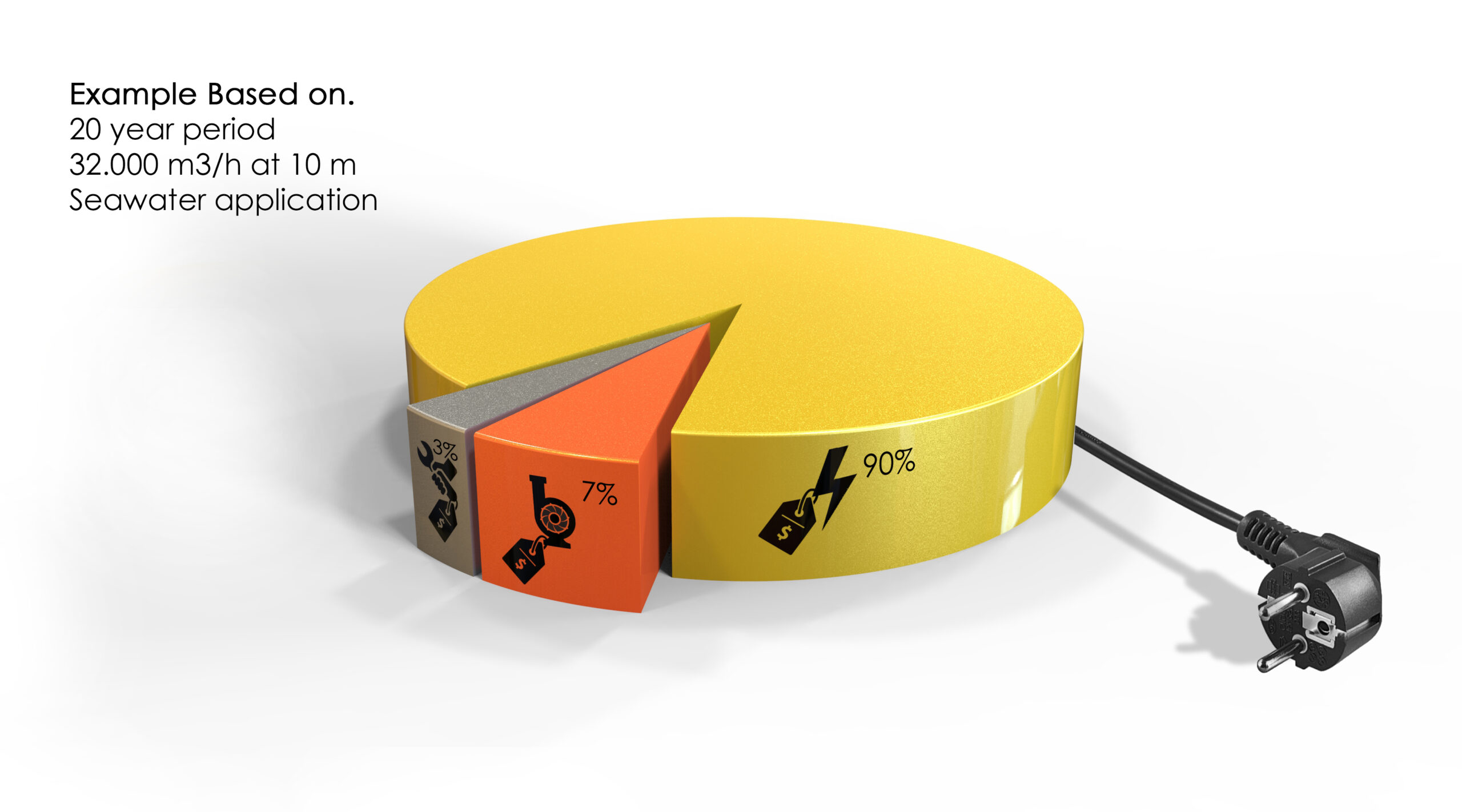
Some other advantages of CVP over VTP are as follows:
Initial investment saving
- CVP 20% less.
Maintenance cost savings
- Mean time between failures (MTBM) VTP 5 years CVP 10 years.
- CVP Spare part inventory virtually zero.
Of course, each project requires its own evaluation with regard to the selection criteria. And it is not feasible for us to show all possibilities in an example on this page. We hope that the examples will be food for thought. And encourage you to consider whether a CVP option is a possibility compared to the usually traditional concepts.
We advise you to talk to us at an early stage. Before concepts are frozen Our people are more than willing to think along with you and look at the possibilities. So that you as a customer can decide which concept suits you best.
More Concrete Volute Pump information
- Rodelta CVP (Concrete Volute Pump)
CVP home page. - Benefits Concrete Volute Pumps
CVP pre-fab benefits.
- Design aspects for CVP pump stations and principles.
Aspects and choices CVP design.
- Constructional design features of CVP pull-out unit
CVP pull-out construction.